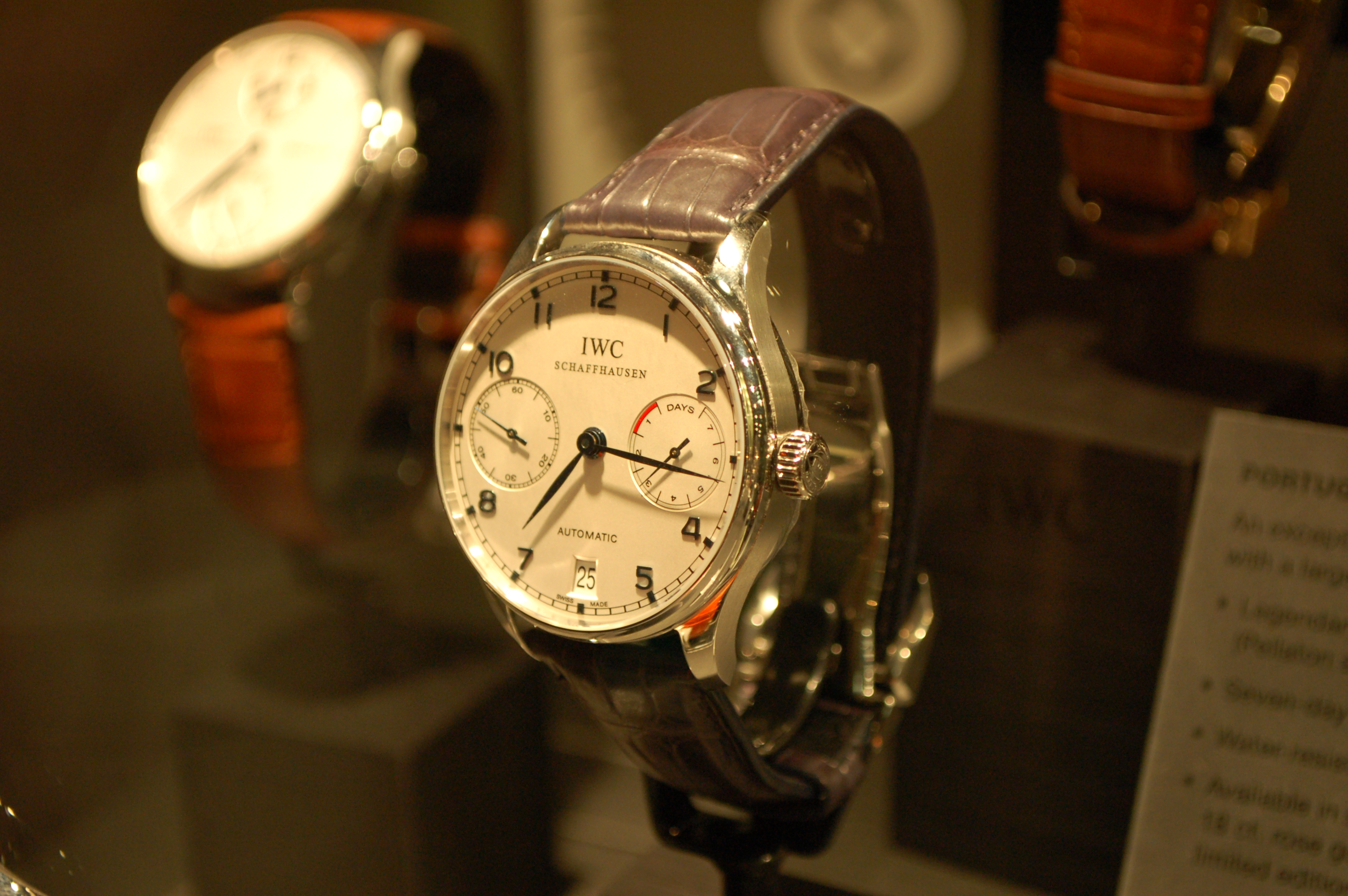
The Portugieser exists because of a problem that no longer exists. In the 1930s, marine chronometers — large, deck-mounted timekeeping instruments used for celestial navigation — were the gold standard of portable precision. Two Portuguese merchants, Rodrigues and Teixeira, wanted that accuracy in a wristwatch. They approached IWC in Schaffhausen, and the Swiss manufacturer did something pragmatic and slightly mad: they took a pocket watch movement, the Hunter caliber 74, and fitted it into a wristwatch case.
The result was a watch that measured 41.5mm in diameter — enormous by 1939 standards, when most men's watches sat between 30 and 35mm. The oversized dimensions accommodated the large movement and gave the dial a clarity that smaller watches could not match. The thin bezel, the railroad minute track, the Arabic numerals, the leaf-shaped hands — all of these elements served legibility. The Portugieser was, in its original form, purely a reading instrument.
Rediscovery in the 1990s
IWC reintroduced the Portugieser family in the early 1990s under the creative direction of Günter Blümlein, the legendary industry figure who also revived A. Lange & Söhne and Jaeger-LeCoultre. The modern Portugieser retained the original's large-diameter, thin-bezeled aesthetic while adding complications: chronograph, minute repeater, perpetual calendar, tourbillon. The ref. 3714, a chronograph with a clean white dial and blue hands, became the collection's ambassador.
The Portugieser proved that a large watch could be elegant — something the industry would take another twenty years to fully understand.
The Portugieser Chronograph remains one of the most balanced designs in IWC's current lineup. The subsidiary dials at three and nine o'clock are symmetrically placed. The date window at three integrates into the seconds sub-dial. The applied Arabic numerals have a typographic quality that gives the watch a bookish, almost literary character. It is the watch for people who read hardcovers and care about typefaces.
Movement and Meaning
Current Portugieser models house IWC's in-house calibers, including the 69355 chronograph movement with column wheel and 46-hour power reserve. The Portugieser Automatic 40, introduced in 2024, brought the collection to a size more aligned with contemporary preferences while maintaining the visual language established eighty-five years ago. The proportions — bezel width, dial opening, numeral scale — are carefully preserved.
What sets the Portugieser apart in a crowded field is its refusal to be a sports watch. In an era when nearly every luxury brand builds its marketing around tool-watch heritage and extreme durability, the Portugieser remains unabashedly a watch for civilized life. It is not water-resistant to 300 meters. It does not have a rotating bezel. It will not survive a deep-sea expedition. It will, however, look magnificent on your wrist while you sit in a café in Lisbon and read the morning paper, which is arguably the more useful accomplishment.