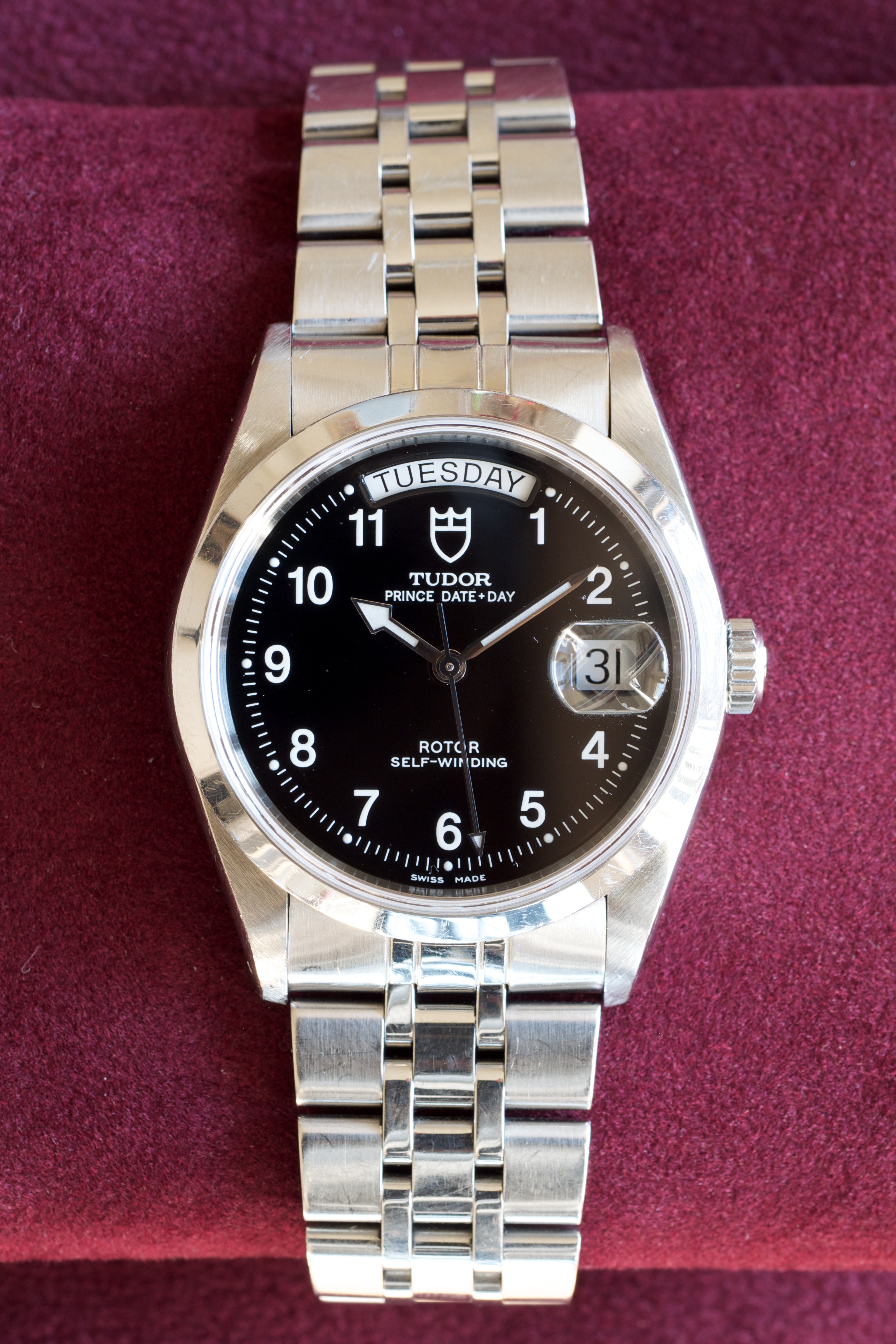
Tudor has always existed in the shadow of its parent company, and the brand's marketing has historically leaned into that relationship rather than away from it. Founded by Hans Wilsdorf in 1946, Tudor was explicitly designed to offer Rolex-level reliability at accessible price points. Early Tudor watches used Rolex cases and movements sourced from third-party suppliers. The message was clear: this is the affordable way into the Rolex universe.
The Black Bay, introduced in 2012, marked the beginning of a different identity. The ref. 79220R drew design cues from Tudor's dive watch heritage — specifically the Submariner-style references from the 1950s and 60s — but assembled them into something that felt like a deliberate creative statement rather than a budget compromise. The domed crystal, the snowflake hands (borrowed from Tudor's 1969 catalog), the gilt dial — these were choices, not concessions.
The In-House Movement Shift
The real pivot came in 2015 when Tudor introduced its first in-house movement, the MT5612, in the Black Bay. At 70 hours of power reserve and COSC certification, the movement exceeded the specifications of many Swiss watches at twice the price. Tudor was no longer borrowing credibility from ETA or Rolex — it was manufacturing its own.
The Black Bay did not try to be a cheap Submariner. It tried to be a good watch at a fair price, and that turned out to be a far more compelling proposition.
The current Black Bay lineup has expanded to include the Black Bay 58 (a 39mm version that wears beautifully on smaller wrists), the Black Bay GMT, the Black Bay Chrono, and a range of dial colors including the burgundy, black, and navy options. The Black Bay 58, in particular, has been a critical and commercial success — its vintage-proportioned case and restrained design make it one of the best daily-wear dive watches at any price point.
Value Proposition
At roughly $3,500 to $4,500 depending on configuration, the Black Bay occupies a strategic price point. It costs enough to signal mechanical watch appreciation but not so much that it becomes an investment piece. It is, in the best sense, a tool watch — something you can wear diving, hiking, or to dinner without concern. The rivet-style bracelet is comfortable. The 200-meter water resistance is genuine. The luminous material is applied generously.
Tudor will always be connected to Rolex, and the brand is smart enough to know that the association helps more than it hurts. But the Black Bay — now a decade into its production run — has established its own gravitational field. It is recommended not as a stepping stone to a Submariner, but as a watch that stands on its own merits. That is perhaps the greatest compliment a Tudor has ever received.