In 1931, a Swiss businessman named César de Trey was watching a polo match in India when a British officer complained that his watch crystal kept breaking during play. De Trey brought the problem to Jacques-David LeCoultre, who along with French engineer René-Alfred Chauvot developed a solution of disarming simplicity: a rectangular case that slides out of its cradle and flips over, presenting a solid metal back to the world while the crystal faces the safety of the wrist.
The mechanism is entirely mechanical — no springs, no catches beyond a small click that holds the case in position. You press the case down, slide it along its rails, and flip it. The action has a tactile satisfaction that digital interfaces have spent decades trying to replicate. Every Reverso owner develops the habit of flipping the case idly, a physical fidget that doubles as a connection to the watch's history.
Art Deco on the Wrist
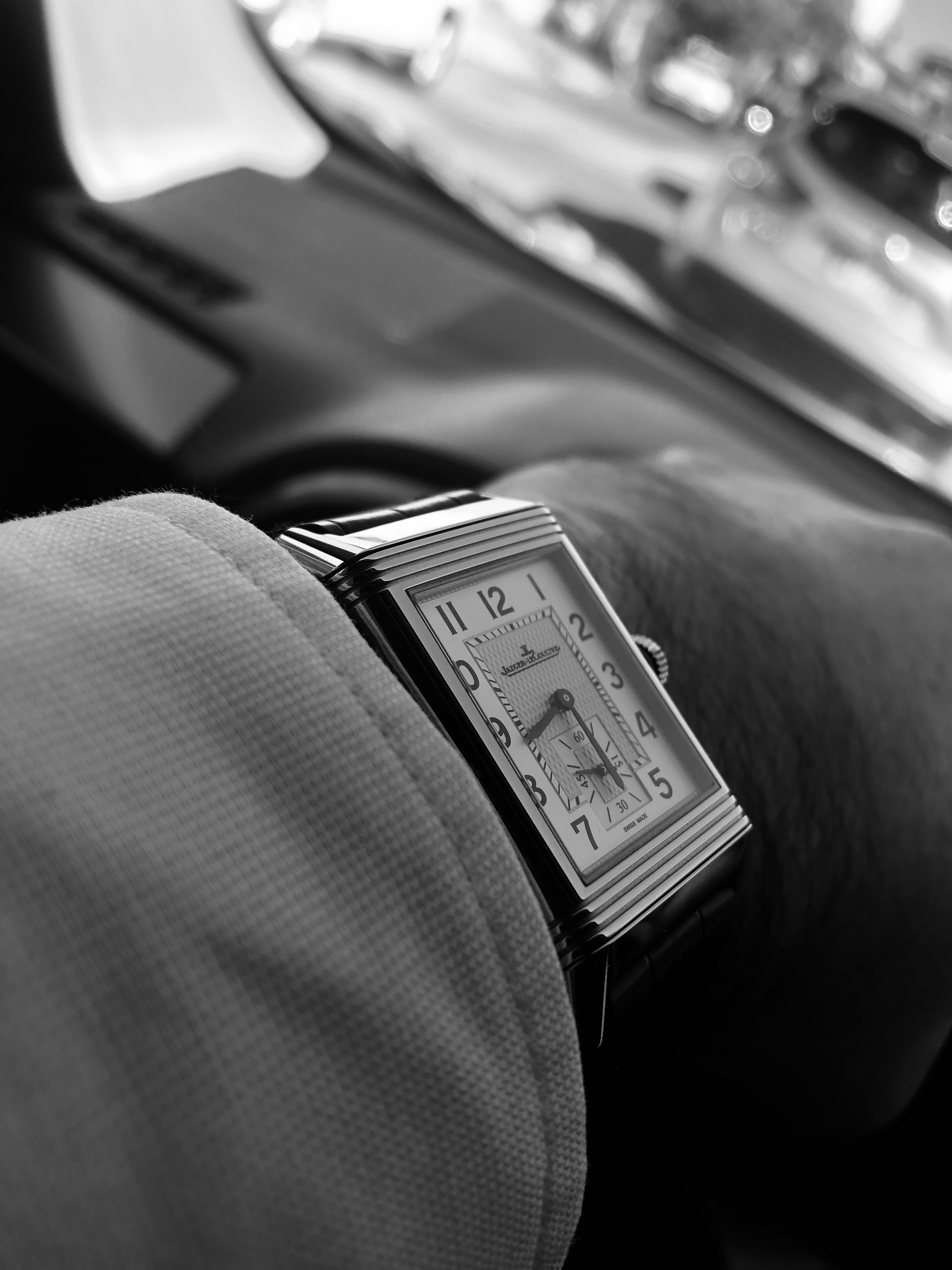
The Reverso is unmistakably a product of the Art Deco period. The rectangular case, the geometric dial layout, the stepped lugs — all of these elements carry the visual language of the 1930s. But unlike many Art Deco objects, the Reverso has never looked dated. Its proportions are clean enough to read as contemporary, and the reversing mechanism gives it a functional novelty that prevents it from becoming purely nostalgic.
Every Reverso case back is a blank canvas — many owners have them engraved, turning the hidden face into something personal. No other watch invites this kind of intimacy by design.
The blank case back became a canvas early in the watch's history. Owners engraved initials, coats of arms, portraits, and messages on the metal surface that faced outward when the watch was flipped. Jaeger-LeCoultre formalized this tradition, and today the case back remains one of the most common surfaces for personalization in all of watchmaking. An engraved Reverso is arguably the most intimate luxury object one can wear.
Modern Complications
Jaeger-LeCoultre has pushed the Reverso concept into remarkable territory. The Reverso Tribute Duoface houses two dials — one on each side of the reversible case — allowing the wearer to track two time zones. The Reverso Hybris Mechanica Calibre 185 contained four faces and eleven complications, including a minute repeater and a perpetual calendar. These are exercises in mechanical ambition, proving that the Reverso architecture can accommodate far more than its original three-hand layout.
The core Reverso collection — the Classic, the Tribute, the One — remains focused on elegant simplicity. The Reverso Tribute Small Seconds in steel, with its silver-grained dial and blue hands, is one of the most handsome watches available under five figures. It wears smaller than its dimensions suggest, sitting flat against the wrist with a compactness that round watches of the same case length cannot match.
In a world of tool watches and ceramic bezels and helium escape valves, the Reverso stands apart as a watch with a party trick that actually works — and that has worked, without modification, for nearly a century. It is proof that the best mechanical ideas are not always the most complex. Sometimes the most enduring innovation is a case that flips.