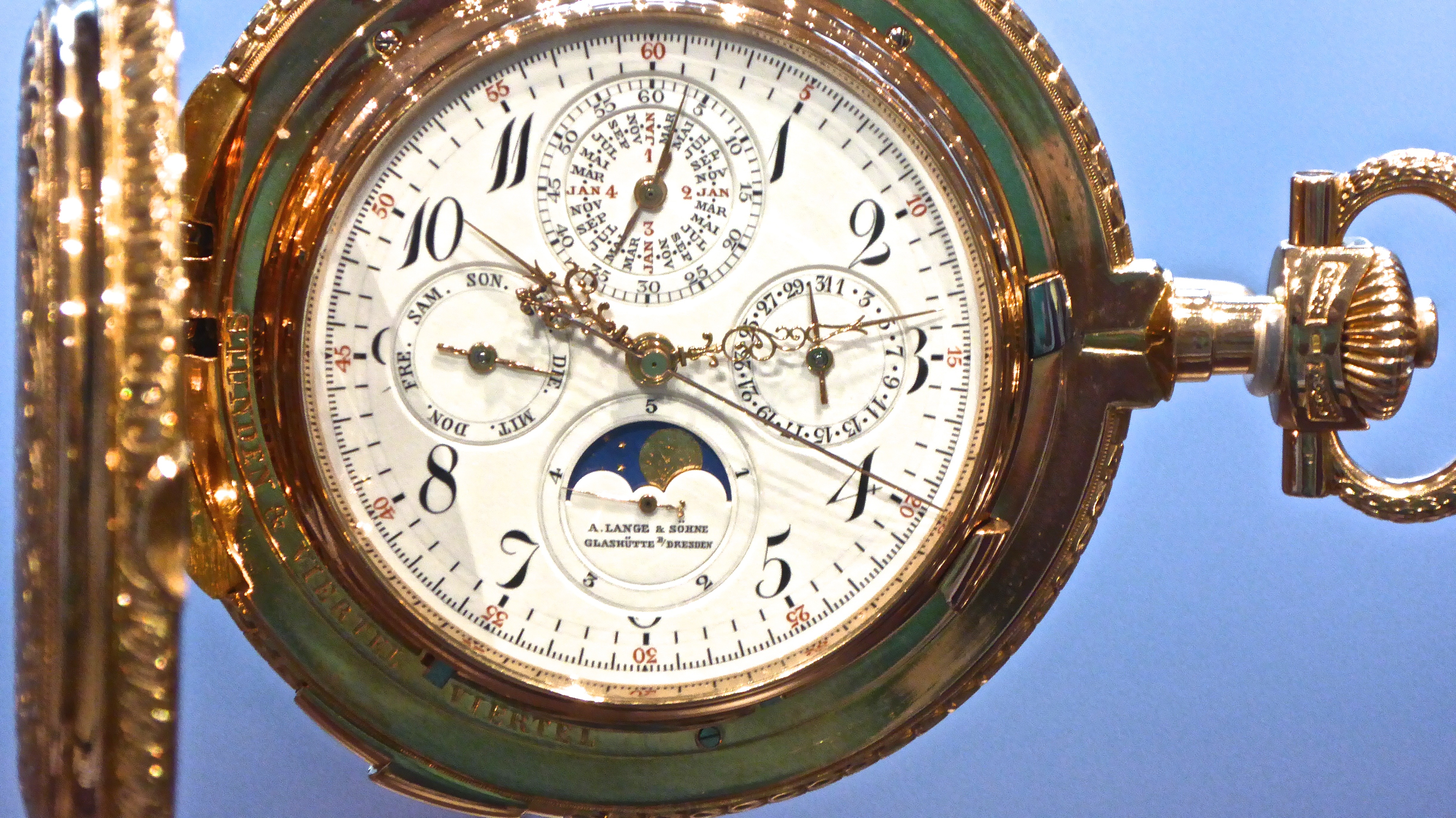
The story of A. Lange & Söhne is inseparable from the story of Germany itself. Ferdinand Adolph Lange founded the company in Glashütte, Saxony, in 1845. For a century, it produced some of the finest pocket watches and wristwatches in Europe. Then, in 1948, the Soviet occupation government expropriated the company and absorbed it into a state-owned collective. The name Lange effectively disappeared from horology for forty-two years.
Walter Lange, Ferdinand's great-grandson, refounded the company on December 7, 1990 — barely a year after the Berlin Wall fell. He had no factory, no employees with experience in fine watchmaking, and a brand name that most of the watch world had forgotten. What he did have was Günter Blümlein, the Richemont-backed executive who would become the architect of the brand's resurrection. Together, they spent four years developing a debut collection in total secrecy.
October 24, 1994
On that date, Lange unveiled four watches simultaneously at the Dresden Palace. The Lange 1 was the star. Its asymmetric dial layout — with the main time display offset to the left, a subsidiary seconds dial at lower left, a power reserve indicator at upper right, and a large outsized date at upper right — broke every rule of conventional dial design. Swiss watches used symmetric layouts. The Lange 1 did not. The effect was jarring and, within weeks, recognized as brilliant.
The Lange 1's asymmetric dial looked wrong until you realized it was the first watch dial designed according to how the eye actually reads information, rather than how a movement's gear train happens to position the hands.
The outsized date — displayed through two separate apertures using a cross mechanism inspired by the five-minute clock at the Dresden Semperoper — was the collection's signature complication. The date digits were significantly larger than those on any competitor, making the function genuinely useful rather than ornamental. This feature alone established a design language that Lange would reference across its entire catalog for the next three decades.
The Movement
Turn the Lange 1 over and you understand the company's true ambition. The caliber L121.1 — visible through a sapphire caseback — is finished to standards that rival or exceed anything produced in Switzerland. Three-quarter plate in untreated German silver (which develops a warm patina over time), hand-engraved balance cock, blued screws heated to exactly 290°C, and gold chatons holding the rubies. Every Lange movement is assembled twice: once to verify function, then disassembled, cleaned, decorated, and assembled again for final adjustment.
The Lange 1 is not inexpensive — current retail for the time-only version in pink gold starts above $40,000. It is also not a watch you will see often. Lange's annual production is estimated at around 5,500 pieces across all models, a fraction of what the Swiss majors produce. But visibility was never the point. The Lange 1 exists to prove that Glashütte's watchmaking tradition survived expropriation, division, and neglect — and emerged with its standards not just intact, but heightened.